THE T.H.R.E.A.D System™
THE T.H.R.E.A.D System™
A Nonlinear Practice-Based Framework for Transforming Pressure into Coherence
Every Pressure Point Carries a Pattern Beneath It.
You have felt it.
- The conflict that resurfaces after every attempted resolution.
- The strategy that produces the same outcome in different languages.
- The leader who keeps encountering the same ceiling.
- The team that fractures along the same invisible line.
- The organization that keeps solving the same problem and calling it something new.
- The community whose inherited conditions outlast the interventions designed to address them.
The pressure is real. Yet pressure rarely tells the whole story. Pressure does not simply descend upon a person, team, organization, or community. It is interpreted, distributed, absorbed, displaced, and converted into decisions, relationships, behaviors, and structures. Beneath every visible pressure point, a pattern is shaping where the pressure travels, who carries it, what the system protects, and what the future is permitted to become.
Some patterns preserve continuity, belonging, dignity, identity, or survival. Others preserve authority, institutional comfort, inherited advantage, or the appearance of stability by transferring uncertainty, silence, labor, and risk to people with less power, while most patterns still serve the whole. Others have outlived the conditions that made them necessary. When these distinctions remain unexamined, patterns harden into routines, routines become culture, and culture quietly reproduces the very conditions an organization says it intends to change.
The connective pattern beneath these visible experiences is what I call The Thread.
The Thread is the pattern through which pressure becomes meaning, meaning that activates repeated responses that impact personal, relational, cultural, and institutional reality.
It runs through every organization that keeps solving the same problem. Every leader who keeps arriving at the same ceiling. Every community whose inherited conditions outlast every intervention designed to address them. Every person who reaches for a different future and finds the same story waiting. The Thread may appear in what is said repeatedly, what is carefully avoided, who is invited into decisions, whose knowledge is trusted, where resources flow, what behavior is rewarded, and who is expected to absorb the cost when the system comes under strain.
The question is not only whether the pattern can be seen. The deeper questions are:
What created it?
What has it protected?
Whom has it protected?
Who has carried its cost?
What must now be preserved, repaired, redistributed, interrupted, or released?
The work of The Thread is to make the pattern visible, examine the story and structure sustaining it, and create the conditions through which a more coherent future can be enacted.
The T.H.R.E.A.D. System~~©~~ ™ is how that work gets done.
The T.H.R.E.A.D. System™
The T.H.R.E.A.D. System™ is a practice-based, nonlinear framework for inquiry, development, and intentional transformation. It helps people and systems examine how pressure is being processed and converted into recurring patterns of interpretation, relationship, behavior, power, and institutional design. The framework supports the movement from visible pressure to deeper pattern recognition, from inherited response to conscious choice, and from temporary intervention to conditions capable of sustaining a different future. It is built for individuals, leaders, youth, teams, organizations, and communities navigating complex change involving identity, memory, behavior, relationships, culture, systems, and future design.
The T.H.R.E.A.D does not assume that change proceeds in a straight line or that insight automatically produces action. People and institutions may move forward, return to earlier questions, uncover a deeper pattern, encounter resistance, revise their interpretation, or discover that the surrounding system continues to reward the behavior they are trying to change. The nonlinear architecture recognizes that transformation is recursive: meaning, relationships, practice, and structure must be revisited as new realities emerge. Organized through four movements and six practices, the framework functions as both a development pathway and a readiness framework. Each practice carries a diagnostic question that helps participants see, name, and act on what transformation requires.
This is where reflection becomes disciplined inquiry. Where lived experience becomes evidence to be examined rather than assumption to be defended. Where insight becomes diagnosis, diagnosis becomes collective action, and action becomes organizational design. Pattern awareness becomes a foundation for human development, leadership practice, organizational transformation, facilitator preparation, community change, and scholarly inquiry.
The framework does not position people as obstacles standing between leadership and the future. It understands people as interpreters, carriers, and potential co-authors of change—and as the places where an institution’s memory, knowledge, contradictions, injuries, loyalties, and unrealized possibilities are often held.
The Thread Check-In
Five Questions. One Entry Point.
Before strategy, planning, programming, or intervention, The T.H.R.E.A.D. System™ begins with five grounding questions.
- What pressure, pain point, contradiction, or recurring tension is demanding attention now?
- Where is that pressure landing, who is carrying it, and what is the human, relational, operational, or institutional cost?
- What interpretation, behavior, relationship, routine, or structural pattern is being repeated beneath the visible problem?
- What future is trying to become possible, and what must change in meaning, relationship, practice, and structure for that future to endure?
- How do we get there?
These questions interrupt the impulse to move immediately from pressure to solution. They create space to distinguish symptoms from systems, activity from transformation, and temporary relief from lasting change. The T.H.R.E.A.D. System™ provides the pathway for pursuing those questions with rigor, courage, participation, and care.
Why This Framework Exists
Every transformational leadership role begins in paradox.
The people carrying an institution’s greatest wisdom may also be carrying the greatest weight of its unresolved contradictions. Leaders inherit institutional history while facing the demand for reinvention. Communities carry memory, loss, resilience, and possibility in the same body. Organizations experience the pressure to preserve what matters while redesigning what no longer works. They must move quickly without becoming careless. They must honor history without allowing history to dictate the future. They must protect continuity while confronting the routines through which inequity, silence, fragmentation, and exhaustion may have become normalized. They must ask people to participate in change without treating participation as a performance whose outcome has already been decided. Across these conditions, a common dynamic appears: pressure has exceeded the capacity of familiar responses, the cost of maintaining the current pattern has become too high or too unevenly distributed, and a different future is pressing to become possible.
The T.H.R.E.A.D. System™ was developed for this threshold.
It was developed for the space between recognition and response: the moment when people know that continuing as before is no longer viable, but the meaning, relationships, practices, and structures required for what comes next have not yet been fully formed. The framework is particularly concerned with what occurs when organizations move too quickly from pressure to action. Under sustained strain, systems may narrow interpretation, centralize authority, intensify control, silence dissent, transfer burden downward, or mistake compliance for transformation. The resulting activity may create movement without producing coherence.
T.H.R.E.A.D. creates a disciplined alternative. It asks how pressure is being processed, how its burden is being distributed, what patterns are being protected, whose knowledge is absent, and what must be redesigned so that change does not depend indefinitely on individual endurance.
Practice-Informed and Open to Empirical Examination
The framework originated through the author’s sustained engagement with organizational transformation across multiple institutional settings and was subsequently developed through an integrative synthesis of relevant scholarship. Practice experience informed the framework’s questions, language, and architecture. It revealed recurring dynamics across personal, organizational, and community settings, but it is not presented as proof of universal effectiveness or as a substitute for systematic empirical examination. The framework should therefore be understood as practice-informed, theoretically developing, and empirically examinable. Its propositions, mechanisms, applications, and limitations must remain open to study, critique, adaptation, and refinement across populations and contexts. This distinction is essential. Experience can identify a phenomenon, expose a contradiction, and generate a consequential question. Research must then examine the conditions under which the proposed explanation holds, where it fails, whose experience it overlooks, and what alternative explanations remain plausible.
Ethical Scope and Boundaries
The system is educational, developmental, reflective, and organizational. It is not psychotherapy or clinical treatment, clinical diagnosis, legal advice, medical care, or crisis intervention. It should be applied with appropriate preparation, ethical boundaries, and referral pathways when clinical, legal, safety, or crisis needs are present. The framework must also be used with attention to power. An invitation to reflect is not ethically neutral when participation is compelled, confidentiality is uncertain, or those naming a harmful pattern may face retaliation. Facilitators and leaders must consider who controls the process, who defines the problem, who has access to the findings, whose interpretation carries authority, and whether participants possess meaningful influence over the decisions that follow.
T.H.R.E.A.D. should not be used to individualize systemic harm, reinterpret legitimate dissent as a personal pattern, compel reconciliation, bypass accountability, or ask people with less institutional power to absorb the emotional labor of repairing conditions they did not create. The T.H.R.E.A.D. System™ emerged through autoethnographic inquiry, a qualitative methodology that treats lived experience as a serious site of knowledge when examined with scholarly rigor, contextual discipline, and intellectual honesty.
Rooted in Critically Reflexive Autoethnographic and Practice-Based Inquiry
The T.H.R.E.A.D. System™ emerged through a critically reflexive engagement with lived experience, professional practice, institutional history, and scholarly literature. Autoethnographic inquiry treats experience as a legitimate site of knowledge when it is interrogated rather than merely narrated, situated within cultural and structural context, and examined with methodological transparency and intellectual discipline. Within this tradition, the personal is neither sufficient evidence nor irrelevant evidence. It is material to be questioned: What does this experience reveal? What remains partial? What cultural, historical, relational, and institutional forces shaped it? Where might memory, authority, identity, or retrospective interpretation distort what can be claimed?
Dr. Mattison’s Jamaican upbringing, ancestral memory, faith formation, recovery from trauma, executive leadership, and sustained work within institutions undergoing disruption served as source material for the framework. Across decades of personal, executive, organizational, and community practice, recurring tensions were examined across multiple levels: the stories people tell, the patterns relationships reproduce, the routines institutions normalize, the forms of pressure leaders absorb or transfer, and the conditions under which systems either contract or become capable of change. These observations were progressively translated into six practices, four movements, and an integrated architecture for transformation.
This foundation allows the framework to hold lived knowledge and scholarly inquiry in productive tension. It does not elevate personal experience above other forms of evidence. It asks how experience can generate questions, reveal systems, challenge abstraction, and remain accountable to perspectives beyond the author’s own.
It connects personal experience to broader questions of leadership, identity, power, culture, systems, and transformation. Women and girls of color, misrepresented, underserved, and resourced communities and organizations remain a priority population within this work. The framework was shaped by close knowledge of what institutional incoherence can cost people whose lives, labor, and leadership have unfolded within systems not designed with their full humanity, knowledge, or authority in view. It was equally shaped by what becomes possible when those who have carried disproportionate institutional weight are no longer treated only as recipients of change, but as interpreters, designers, decision-makers, and authors of what comes next.
That origin does not limit the framework’s reach. It gives the work its roots. Its wider applicability must not erase those roots. Instead, its development should continually test whether the framework honors difference, surfaces power, protects dignity, and remains responsive to people whose knowledge has historically been extracted, minimized, or excluded.
Four Movements. A Recursive Architecture for Transformation
The T.H.R.E.A.D. System™ moves through four directions, each answering a distinct question about how pressure becomes pattern and how patterned response can become intentional transformation. These movements are not fixed stages. They are recursive orientations that may be revisited as new knowledge, resistance, relationships, and consequences emerge.
- Inward. Before action, there must be interpretive space. The Inward movement creates the pause that clarity requires, the discipline of slowing down enough to understand what is actually happening before deciding what to do about it. Pressure compresses attention. It can make the first explanation feel like the only explanation, urgency feel like certainty, and familiar action feel safer than deeper inquiry. The Inward movement interrupts that compression. It asks participants to notice assumptions, emotional signals, habitual interpretations, unspoken fears, and the limits of their present view. Its purpose is not reflection for its own sake. It is interpretive differentiation: expanding what can be seen, named, questioned, and understood before action narrows the field again.
Central question: How do we know what we think we know?
- Backward. The past is not behind an organization. It remains active in memory, identity, trust, routine, structure, and expectation.
The Backward movement draws insight from what has already happened, identifying the responses, structures, and assumptions that have reached the end of their usefulness. It examines how the present became possible: which decisions established the pattern, what earlier conditions made the response adaptive, what was learned, what was silenced, what remains unresolved, and how prior experiences continue to shape what people believe is safe, credible, or possible. The Backward movement does not romanticize history or treat inherited practice as inherently wise. It recovers knowledge while also examining protective asymmetry: whether a pattern preserved stability or legitimacy for some by transferring burden, uncertainty, exclusion, or harm to others. Central questions: How did this reality become possible? What has this pattern protected, for whom, and at what cost?
- Outward. Transformation does not happen alone. The Outward movement recognizes that awareness held by one person does not become transformation until the capacity to interpret, influence, and act is relationally distributed. Trust, voice, credible participation, shared accountability, and aligned support are not supplementary features of change. They determine whether insight can travel through the system without being diluted, resisted, captured, or silenced. This movement distinguishes genuine participation from participation theater. People are not meaningfully included simply because they are informed, surveyed, consulted, or invited into a room. Participation becomes consequential when people can shape the interpretation of the problem, influence the design of the response, question assumptions without retaliation, and participate in decisions affecting the work they will be expected to carry. The purpose of the Outward movement is relational authorization: building the network of trust, authority, knowledge, and coordinated responsibility through which a different pattern can become collectively possible.
Central question: Who must participate in interpreting, authorizing, and carrying the work?
- Forward. Insight that does not alter practice or structure remains vulnerable to the pattern it has exposed. The Forward movement translates everything gathered inward, backward, and outward into intentional design: behaviors, decisions, structures, and systems aligned with the future being built. It begins through enactment—testing new practices, learning from consequence, and revising what does not work. It continues through structural recomposition: aligning authority, roles, technologies, incentives, measures, resource flows, policies, and accountability with the intended future. Without this alignment, people may perform new behaviors while the surrounding institution continues to reward the old ones. The result is often adoption without transformation: temporary compliance, localized progress, or improvement sustained only through extraordinary individual effort. The Forward movement asks what must change so the new way of working is not dependent upon heroics, punished by the system, or gradually pulled back into the previous pattern.
Central question: What must be enacted, resourced, measured, and structurally reinforced?
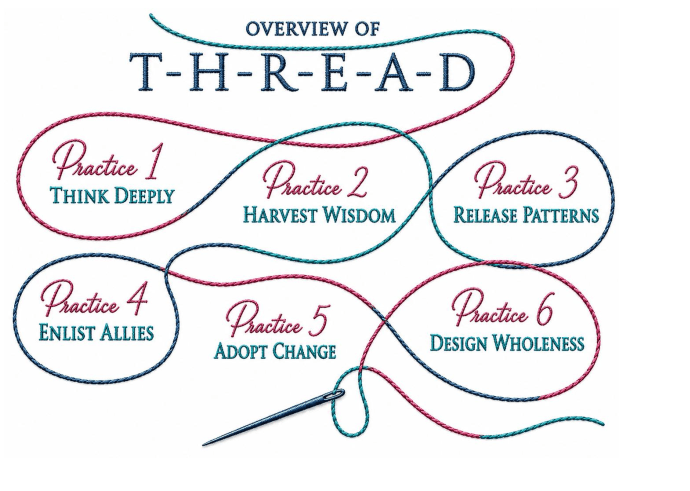
The six practices form the pathway from pressure to pattern clarity to coherent design. Each practice carries a diagnostic question that helps participants examine transformation readiness and determine what the next movement requires:
Our Platform – The Thread Movement™
The broader body of work, learning experiences, media, tools, partnerships, research, and community that carries the methodology to the people and systems it is designed to serve.

Think Deeply
Engage in disciplined self-inquiry to clarify the values that guide you, the vision that calls you forward, and the purpose that anchors your leadership.

Harvest Wisdom
Gather the lessons embedded in your lived experience, recognizing that every success, failure, rupture, and return holds insight, if you are willing to listen.

Release Patterns
Let go of habits, beliefs, and identities that once offered protection but now limit your growth by honoring what was and making space for what must emerge.

Enlist Allies
Build relationships rooted in trust, shared vision, and mutual accountability because transformation is sustained not in isolation, but in community.

Adopt Change
Align your actions with the transformation you seek, turning insight into embodiment and intention into impact.

Design Wholeness
Shape systems, cultures, and structures that reflect your deepest commitments and support the flourishing of people, purpose, and place.
Look Inward Beneath the Invisible
Transformation begins not with action, but with awareness. Think Deeply is the first shift in The T.H.R.E.A.D. System™, and serves as the foundation for intentional change. It invites leaders, teams, and institutions to pause and reflect on who they are, how they operate, and what the future now requires. In fast-paced environments where speed is mistaken for progress, this discipline creates space to surface the misalignments between purpose and practice, as well as between values and behavior.
This step challenges both individuals and organizations to examine inherited assumptions and unspoken norms. It brings cultural tensions, strategic contradictions, and identity drift into view. When practiced with discipline, Think Deeply helps realign actions with mission, decisions with values, and direction with integrity. It is the threshold where transformation begins—with presence, not performance.
When You Think Deeply
- Pause to clarify purpose before building strategy
- Create intentional space for cross-functional dialogue
- Surface contradictions between stated values and daily practice
- Engage teams and communities in honest, future-oriented reflection
- Make decisions grounded in shared meaning and institutional identity
Think Deeply in Practice Across every sector I’ve served, deep listening has been the foundation of sustainable transformation. Before any major initiative, I initiate structured engagements—listening forums, confidential interviews, and cross-functional dialogues—to surface unspoken truths. Stakeholders are invited into a central inquiry: What is this institution being called to become, and are we aligned with that call? These conversations illuminate disconnects between values and behaviors, surface underutilized wisdom, and re-anchor strategy in shared purpose. When listening becomes a collective discipline, trust deepens, culture becomes more coherent, and change takes root from within.
Think Deeply Reflection Matrix
| Self | Community | Organization |
|---|---|---|
|
What values am I demonstrating through
my presence and decision-making? |
What are we assuming because pressure has made it difficult to see differently? |
To what extent do our strategies reflect
the future we aspire to create? |
|
What aspects of my leadership identity are
evolving, and what beliefs or behaviors
must I release to grow? |
How do our team dynamics amplify or
obstruct our collective goals and values? |
What legacy structures, narratives, or
norms are shaping our direction—and
are they still relevant? |
Outcomes of Thinking Deeply
When practiced consistently, Think Deeply enables leaders to respond to complexity with clarity and courage. Individuals experience renewed alignment between their values and actions. Teams build cohesion through shared reflection and purpose. Organizations reconnect their strategy with their mission and begin to shift their culture from reactive to reflective. Trust strengthens, energy realigns, and transformation gains a grounded foundation. In a world of constant motion, this kind of clarity becomes a strategic asset.
Look Backward for Lessons Learned
Harvest Wisdom builds on the clarity established in Step One by turning inward and outward to surface the insights already embedded within your system. It is a strategic discipline of listening across multiple channels: data, dialogue, lived experience, and intuition. It uncovers what metrics alone cannot explain.
During moments of transition or uncertainty, institutions often default to external benchmarking and top-down decisions. Harvest Wisdom challenges that reflex. It invites the question: What do we already know but have not fully acknowledged or understood? Wisdom is seen not as a commodity but as a relational process that emerges from honoring complexity, diverse perspectives, and patterns that span roles, timelines, and experiences.
In practice, this means creating intentional feedback loops, gathering stories from across the organization, and integrating quantitative data with qualitative insight. Harvesting Wisdom is about turning to your people and your past to activate the intelligence already present in your culture.
When You Harvest Wisdom
- Center diverse ways of knowing including narrative, emotion, and experience
- Facilitate inclusive conversations that welcome dissent and diverse truths
- Translate individual insight into shared understanding and direction
- Ensure those historically excluded are included in meaning-making processes
- Resist premature answers and hold space for complexity to emerge
Harvest Wisdom Reflection Matrix
| Self | Community | Organization |
|---|---|---|
|
What experiences or insights have I
ignored that may offer guidance? |
What does our history know that our current urgency is overlooking? |
Are we making decisions based on full
narratives or convenient ones? |
|
Where am I operating from assumption
rather than inquiry? |
How do we balance data, story, and
emotion in how we learn together? |
What historical patterns require
reflection before moving forward? |
Outcomes of Harvesting Wisdom
When leaders and institutions commit to listening deeply, previously hidden knowledge surfaces. Leaders recognize undervalued assets and unseen risks. Teams begin to see connections across silos. Organizations transition from reactive analysis to reflective learning. The result is not just insight. It is integration. Culture becomes more coherent. Trust grows. Decision-making reflects shared meaning. Harvest Wisdom equips institutions to navigate change with clarity, compassion, and collective intelligence.
Look Backward for Lessons Learned
Release Patterns is the turning point in the T.H.R.E.A.D. System™. It invites leaders and institutions to courageously confront the habits, roles, structures, and narratives that no longer align with who they are becoming. Where Step One clarifies purpose and Step Two surfaces insight, Step Three asks: What must we release to move forward with integrity?
In systems under pressure, there is a tendency to double down on what has worked in the past. But transformation requires disruption. Releasing Patterns is not about abandoning tradition or erasing history. It is about discerning what has outlived its usefulness and choosing to evolve.
In practice, this involves revisiting legacy policies, confronting entrenched behaviors, and questioning cultural norms that prioritize comfort over growth. It also includes letting go of outdated self-concepts, leadership identities, or organizational myths that limit possibility. This step often surfaces grief, resistance, and uncertainty. But on the other side of release is renewal.
When You Release Patterns
- Name inherited assumptions that constrain innovation
- Interrupt cycles of avoidance, perfectionism, or over-functioning
- Create conditions where individuals and teams can question without fear
- Lead through ambiguity with transparency and courage
- Honor what came before while making space for what wants to emerge
Release Patterns Reflection Matrix
| Self | Community | Organization |
|---|---|---|
|
What beliefs or habits are keeping me
in roles I’ve outgrown? |
What has this pattern protected, and what would
make it safe enough to loosen? |
What traditions or structures are no longer
aligned with our mission? |
|
Where am I clinging to certainty instead
of opening to change? |
What do we need to stop doing to make
room for real progress? |
Where are we performing alignment rather
than living it? |
Outcomes of Releasing Patterns
Letting go of outdated patterns liberates energy, clarifies direction, and makes room for new possibility. On the individual level, leaders experience greater authenticity and adaptability. Teams develop healthier norms and improved collaboration. Institutions nshed performative practices and become more responsive to current needs. Releasing Patterns is not a loss; it is a return to alignment. It clears the space for transformation to take root and thrive.
Reach Outward for Healthy Support
Enlisting Allies is the turning point in the T.H.R.E.A.D. System™, where transformation moves beyond the individual or inner circle to become a shared, institutional effort. Having thought deeply, harvested wisdom, and released outdated patterns, the next imperative is to build coalitions rooted in trust, accountability, and a shared sense of purpose.
Too often, change efforts are isolated to senior leaders or a small group of decision-makers. Enlist Allies challenges that model by recognizing that sustainable transformation requires distributed leadership. This step invites leaders to identify, engage, and activate allies across all levels and constituencies, especially those whose voices have historically been marginalized or excluded.
In practice, Enlisting Allies means creating spaces where stakeholders co-create vision, shape strategy, and steward implementation. It requires courage to share power, humility to learn from others, and the patience to build trust over time. It is not consensus seeking, but rather alignment-building through honest dialogue and mutual accountability.
When You Enlist Allies
- Share power and expand decision-making tables to include diverse stakeholders
- Build relational trust across lines of difference, discipline, and identity
- Foster collective ownership of vision, goals, and metrics for success
- Communicate transparently and model vulnerability as a strength
- Prioritize collaboration over control to build lasting commitment
Enlist Allies Reflection Matrix
| Self | Community | Organization |
|---|---|---|
|
Who am I accountable to, and how do I
show it in practice?
|
Who must help interpret and carry the change?
|
Are we distributing leadership or
concentrating authority?
|
|
Where do I need to relinquish control to
empower others?
|
How are we ensuring all voices are heard
and valued?
|
How do our systems reward collaboration
and shared success? |
Outcomes of Enlisting Allies
When leaders commit to enlisting allies, transformation becomes a collective movement. Individuals feel more seen, valued, and empowered. Teams operate with higher trust and mutual accountability. Organizations shift from siloed power structures to inclusive ecosystems where shared purpose drives coordinated action. Momentum becomes sustainable because it is rooted in community, not compliance. Enlist Allies ensures that transformation is not only initiated but also embedded in the cultural fabric of the institution.
Move Forward to Your Becoming
Adopt Change moves transformation from concept to commitment. It calls on leaders, teams, and institutions to embody the changes they’ve envisioned by aligning their behaviors, structures, and systems with a newly clarified purpose and collective insight. Transformation loses credibility when it is only aspirational. Adopt Change ensures it becomes actionable.
In this step, leaders move beyond declaring a new vision to modeling it in their leadership style, including how they lead meetings, structure incentives, respond to setbacks, and engage their communities. It is through daily decisions and shared practices that change becomes a cultural norm rather than an isolated initiative.
This shift also requires confronting organizational resistance, not as an obstruction but as information. Resistance often signals misalignment, fear, or exhaustion. Leaders who adopt change effectively acknowledge these realities while reinforcing the institution’s commitment to its emerging identity.
When You Adopt Change
- Align words and actions to demonstrate commitment to transformation
- Reinforce new behaviors through policy, ritual, and recognition
- Address resistance with empathy while holding steady to direction
- Make adaptive learning part of strategy, not just execution
- Model vulnerability, resilience, and the courage to lead by example
Adopt Change Reflection Matrix
| Self | Community | Organization |
|---|---|---|
|
How am I embodying the change I
want to lead?
|
What must people begin doing differently together?
|
Do our systems and incentives reflect our
transformed purpose?
|
|
Where do I default to old patterns
under pressure?
|
How do we navigate setbacks as learning
opportunities?
|
Are we resourcing change adequately and
equitably?
|
Outcomes of Adopting Change
When leaders consistently model change, it builds trust and accelerates cultural adoption. Teams experience greater clarity, consistency, and accountability. Organizations shift from episodic initiatives to sustained transformation. Strategy becomes a lived experience, not just a document. Adopt Change establishes the habits, systems, and symbolic acts that give transformation its staying power.
Move Forward to Your Becoming
Design Wholeness is the culminating shift in the T.H.R.E.A.D. System™. It invites leaders to move beyond change as a series of isolated initiatives and instead build systems, structures, and cultures that are regenerative, coherent, and human-centered. When the work of transformation begins within and ripples outward, the natural outcome is a system that embodies integrity at every level.
This step is not about perfection; it is about integration. It asks leaders and institutions to align values with operations, strategy with culture, and aspiration with accountability. It challenges organizations to design from a place of wholeness, not just for efficiency or optics. In environments shaped by fragmentation, burnout, and inequity, Design Wholeness offers a new standard: institutional systems that reflect care, dignity, sustainability, and shared purpose.
When You Design Wholeness
- Integrate mission into every facet of operations and governance
- Prioritize the well-being of people alongside institutional performance
- Build feedback systems that are dynamic, responsive, and equitable
- Design from coherence rather than control
- Model regenerative leadership and long-term thinking
Design Wholeness Reflection Matrix
| Self | Community | Organization |
|---|---|---|
|
Am I creating rhythms that support my
own sustainability and clarity? |
What structures must change so the new practice is not punished or reversed?
|
Are our systems designed to support equity, belonging, and collective impact?
|
|
How do I align my daily actions with my
deepest values?
|
How do we restore energy and cohesion
when disruptions occur?
|
Where are we still upholding systems thatundermine the future we say we’re building? |
Outcomes of Designing Wholeness
When wholeness becomes a design principle rather than an afterthought, transformation becomes sustainable. Individuals experience alignment between values and daily practice. Teams operate with deeper trust, mutual respect, and coherence. Institutions evolve into systems where strategy, culture, and care reinforce one another. Design Wholeness equips organizations to thrive in complexity while remaining grounded in purpose. This is where transformation becomes legacy.
The T.H.R.E.A.D. System™ must be used with respect for participant agency, cultural context, lived experience, psychological safety, confidentiality, and appropriate boundaries. Facilitators, educators, leaders, and organizational partners should avoid using the framework to diagnose, pressure disclosure, force vulnerability, resolve clinical trauma, or substitute reflection for needed structural change. The system is strongest when used to support discernment, learning, alignment, accountability, and humane transformation.