
How the practices move
Six Movements. A Recursive Architecture for Transformation
The T.H.R.E.A.D. System™ moves through six directions, each answering a distinct question about how pressure becomes pattern and how patterned response can become intentional transformation. These movements are not fixed stages. They are recursive orientations that may be revisited as new knowledge, resistance, relationships, and consequences emerge.
Inward
Think DeeplyBefore action, there must be interpretive space. The Inward movement creates the pause that clarity requires, the discipline of slowing down enough to understand what is actually happening before deciding what to do about it. Pressure compresses attention. It can make the first explanation feel like the only explanation, urgency feel like certainty, and familiar action feel safer than deeper inquiry. The Inward movement interrupts that compression. It asks participants to notice assumptions, emotional signals, habitual interpretations, unspoken fears, and the limits of their present view. Its purpose is not reflection for its own sake. It is interpretive differentiation: expanding what can be seen, named, questioned, and understood before action narrows the field again.
Central question
How do we know what we think we know?
Backward
Harvest WisdomThe past is not behind an organization. It remains active in memory, identity, trust, routine, structure, and expectation.
The Backward movement draws insight from what has already happened, identifying the responses, structures, and assumptions that have reached the end of their usefulness. It examines how the present became possible: which decisions established the pattern, what earlier conditions made the response adaptive, what was learned, what was silenced, what remains unresolved, and how prior experiences continue to shape what people believe is safe, credible, or possible. The Backward movement does not romanticize history or treat inherited practice as inherently wise. It recovers knowledge while also examining protective asymmetry: whether a pattern preserved stability or legitimacy for some by transferring burden, uncertainty, exclusion, or harm to others.
Central questions
How did this reality become possible?
What has this pattern protected, for whom, and at what cost?
Downward
Release PatternsBeneath every presenting condition lies the pattern that sustains it. The Downward movement goes below the surface of the problem to the beliefs, habits, protective responses, and structural arrangements that keep reproducing it. It asks what a pattern was built to protect, what it costs now, and what must be released, interrupted, or retired so that something different can take root. Release is not erasure. It honors what a response once made possible while refusing to let it govern what comes next.
Central question
What must be released for something different to take root?
Outward
Enlist AlliesTransformation does not happen alone. The Outward movement recognizes that awareness held by one person does not become transformation until the capacity to interpret, influence, and act is relationally distributed. Trust, voice, credible participation, shared accountability, and aligned support are not supplementary features of change. They determine whether insight can travel through the system without being diluted, resisted, captured, or silenced. This movement distinguishes genuine participation from participation theater. People are not meaningfully included simply because they are informed, surveyed, consulted, or invited into a room. Participation becomes consequential when people can shape the interpretation of the problem, influence the design of the response, question assumptions without retaliation, and participate in decisions affecting the work they will be expected to carry. The purpose of the Outward movement is relational authorization: building the network of trust, authority, knowledge, and coordinated responsibility through which a different pattern can become collectively possible.
Central question
Who must participate in interpreting, authorizing, and carrying the work?
Upward
Adopt ChangeChange becomes real when it is practiced. The Upward movement carries insight into embodiment, lifting new ways of thinking, relating, and working into daily practice until they hold under pressure. It asks people to rehearse the new pattern, learn from consequence, and build the capacity to sustain it, rather than waiting for certainty before acting. Upward movement is gradual and recursive: each attempt strengthens what the next one can carry.
Central question
What new practice must we rehearse until it holds under pressure?
Forward
Design WholenessInsight that does not alter practice or structure remains vulnerable to the pattern it has exposed. The Forward movement translates everything gathered inward, backward, and outward into intentional design: behaviors, decisions, structures, and systems aligned with the future being built. It begins through enactment: testing new practices, learning from consequence, and revising what does not work. It continues through structural recomposition: aligning authority, roles, technologies, incentives, measures, resource flows, policies, and accountability with the intended future. Without this alignment, people may perform new behaviors while the surrounding institution continues to reward the old ones. The result is often adoption without transformation: temporary compliance, localized progress, or improvement sustained only through extraordinary individual effort. The Forward movement asks what must change so the new way of working is not dependent upon heroics, punished by the system, or gradually pulled back into the previous pattern.
Central question
What must be enacted, resourced, measured, and structurally reinforced?
Inward, Backward, Outward, and Forward are the four movements published in The Thread Movement Journal, Issue One (2026). Downward and Upward extend that architecture and remain in continued development.
The research and the boundaries
The Scholarship Behind the System
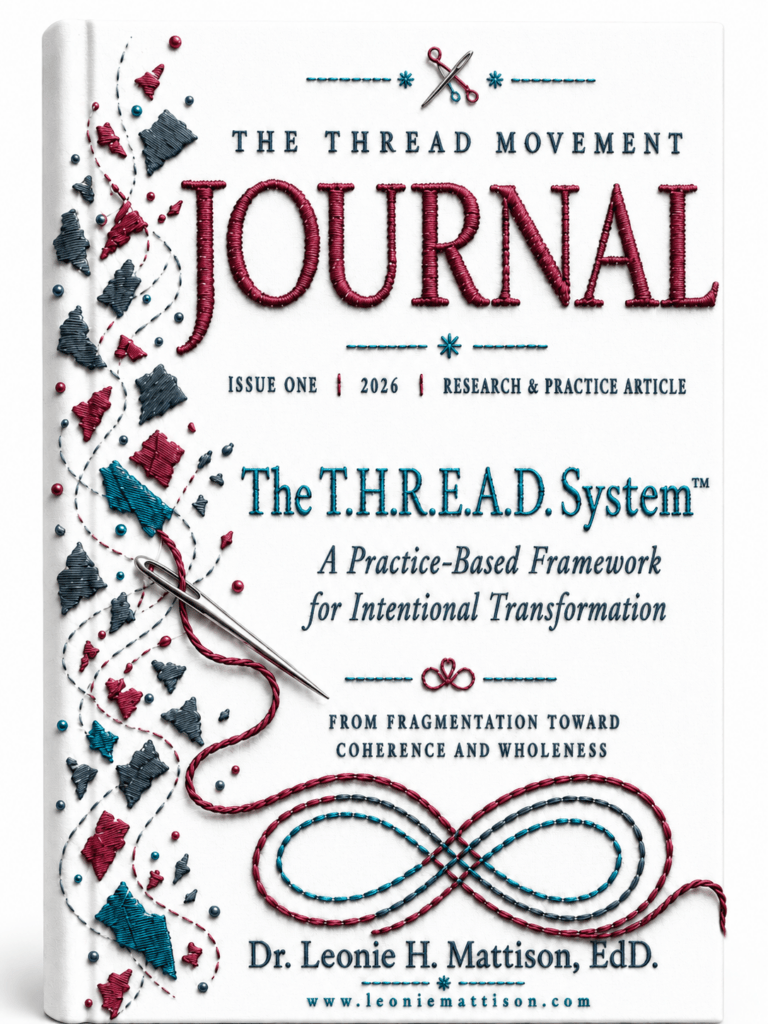
The research behind this page
The Thread Movement Journal
Issue One, 2026
The full article behind everything on this page. It sets out the six practices and the published movements, the critically reflexive autoethnographic method that shaped them, the quilting epistemology rooted in my grandmother’s verandah, and the framework’s explicit nonclinical scope.
- Six practices
- Four published movements
- Autoethnographic method
- Nonclinical scope
Why This Framework Exists
Every transformational leadership role begins in paradox.
The people carrying an institution’s greatest wisdom may also be carrying the greatest weight of its unresolved contradictions. Leaders inherit institutional history while facing the demand for reinvention. Communities carry memory, loss, resilience, and possibility in the same body. Organizations experience the pressure to preserve what matters while redesigning what no longer works. They must move quickly without becoming careless. They must honor history without allowing history to dictate the future. They must protect continuity while confronting the routines through which inequity, silence, fragmentation, and exhaustion may have become normalized. They must ask people to participate in change without treating participation as a performance whose outcome has already been decided. Across these conditions, a common dynamic appears: pressure has exceeded the capacity of familiar responses, the cost of maintaining the current pattern has become too high or too unevenly distributed, and a different future is pressing to become possible.
The T.H.R.E.A.D. System™ was developed for this threshold.
It was developed for the space between recognition and response: the moment when people know that continuing as before is no longer viable, but the meaning, relationships, practices, and structures required for what comes next have not yet been fully formed. The framework is particularly concerned with what occurs when organizations move too quickly from pressure to action. Under sustained strain, systems may narrow interpretation, centralize authority, intensify control, silence dissent, transfer burden downward, or mistake compliance for transformation. The resulting activity may create movement without producing coherence.
T.H.R.E.A.D. creates a disciplined alternative. It asks how pressure is being processed, how its burden is being distributed, what patterns are being protected, whose knowledge is absent, and what must be redesigned so that change does not depend indefinitely on individual endurance.
Practice-Informed and Open to Empirical Examination
The framework originated through the author’s sustained engagement with organizational transformation across multiple institutional settings and was subsequently developed through an integrative synthesis of relevant scholarship. Practice experience informed the framework’s questions, language, and architecture. It revealed recurring dynamics across personal, organizational, and community settings, but it is not presented as proof of universal effectiveness or as a substitute for systematic empirical examination. The framework should therefore be understood as practice-informed, theoretically developing, and empirically examinable. Its propositions, mechanisms, applications, and limitations must remain open to study, critique, adaptation, and refinement across populations and contexts. This distinction is essential. Experience can identify a phenomenon, expose a contradiction, and generate a consequential question. Research must then examine the conditions under which the proposed explanation holds, where it fails, whose experience it overlooks, and what alternative explanations remain plausible.
Ethical Scope and Boundaries
The system is educational, developmental, reflective, and organizational. It is not psychotherapy or clinical treatment, clinical diagnosis, legal advice, medical care, or crisis intervention. It should be applied with appropriate preparation, ethical boundaries, and referral pathways when clinical, legal, safety, or crisis needs are present. The framework must also be used with attention to power. An invitation to reflect is not ethically neutral when participation is compelled, confidentiality is uncertain, or those naming a harmful pattern may face retaliation. Facilitators and leaders must consider who controls the process, who defines the problem, who has access to the findings, whose interpretation carries authority, and whether participants possess meaningful influence over the decisions that follow.
T.H.R.E.A.D. should not be used to individualize systemic harm, reinterpret legitimate dissent as a personal pattern, compel reconciliation, bypass accountability, or ask people with less institutional power to absorb the emotional labor of repairing conditions they did not create. The T.H.R.E.A.D. System™ emerged through autoethnographic inquiry, a qualitative methodology that treats lived experience as a serious site of knowledge when examined with scholarly rigor, contextual discipline, and intellectual honesty.
The T.H.R.E.A.D. System™ must be used with respect for participant agency, cultural context, lived experience, psychological safety, confidentiality, and appropriate boundaries. Facilitators, educators, leaders, and organizational partners should avoid using the framework to diagnose, pressure disclosure, force vulnerability, resolve clinical trauma, or substitute reflection for needed structural change. The system is strongest when used to support discernment, learning, alignment, accountability, and humane transformation.
Rooted in Critically Reflexive Autoethnographic and Practice-Based Inquiry
The T.H.R.E.A.D. System™ emerged through a critically reflexive engagement with lived experience, professional practice, institutional history, and scholarly literature. Autoethnographic inquiry treats experience as a legitimate site of knowledge when it is interrogated rather than merely narrated, situated within cultural and structural context, and examined with methodological transparency and intellectual discipline. Within this tradition, the personal is neither sufficient evidence nor irrelevant evidence. It is material to be questioned: What does this experience reveal? What remains partial? What cultural, historical, relational, and institutional forces shaped it? Where might memory, authority, identity, or retrospective interpretation distort what can be claimed?
Dr. Mattison’s Jamaican upbringing, ancestral memory, faith formation, recovery from trauma, executive leadership, and sustained work within institutions undergoing disruption served as source material for the framework. Across decades of personal, executive, organizational, and community practice, recurring tensions were examined across multiple levels: the stories people tell, the patterns relationships reproduce, the routines institutions normalize, the forms of pressure leaders absorb or transfer, and the conditions under which systems either contract or become capable of change. These observations were progressively translated into six practices, four movements, and an integrated architecture for transformation.
This foundation allows the framework to hold lived knowledge and scholarly inquiry in productive tension. It does not elevate personal experience above other forms of evidence. It asks how experience can generate questions, reveal systems, challenge abstraction, and remain accountable to perspectives beyond the author’s own.
It connects personal experience to broader questions of leadership, identity, power, culture, systems, and transformation. Women and girls of color, misrepresented, underserved, and resourced communities and organizations remain a priority population within this work. The framework was shaped by close knowledge of what institutional incoherence can cost people whose lives, labor, and leadership have unfolded within systems not designed with their full humanity, knowledge, or authority in view. It was equally shaped by what becomes possible when those who have carried disproportionate institutional weight are no longer treated only as recipients of change, but as interpreters, designers, decision-makers, and authors of what comes next.
That origin does not limit the framework’s reach. It gives the work its roots. Its wider applicability must not erase those roots. Instead, its development should continually test whether the framework honors difference, surfaces power, protects dignity, and remains responsive to people whose knowledge has historically been extracted, minimized, or excluded.
One method, many places
Where The Thread Lives
Like a quilt, each piece carries the same thread into a different part of the work.
The Thread Movement Journal
Issue One (2026) presents the T.H.R.E.A.D. System in full, including its methods and scope.
Read the journalThe Thread Assessments
Reflective tools for individuals, leaders, teams, and organizations, including THE THREAD Check-In™, the Leadership Self-Reflection, the Institutional Coherence Index, and the AI Readiness Assessment.
Coming soonAchieve Intentional Transformation
The podcast: conversations that nourish the person behind the leader.
ListenTHE THREAD, LLC
Organizational and talent development, and responsible AI adoption, for institutions.
Visit THE THREAD, LLCThe Thread Movement
Programs for women, youth, and community partners, including W.A.I.T. and FutureWoven™. The Thread Movement is fiscally sponsored by the Santa Barbara Foundation.
Visit the MovementThe Thread Institute
The learning platform that serves both, with courses and mentoring grounded in the System.
Visit the Institute